
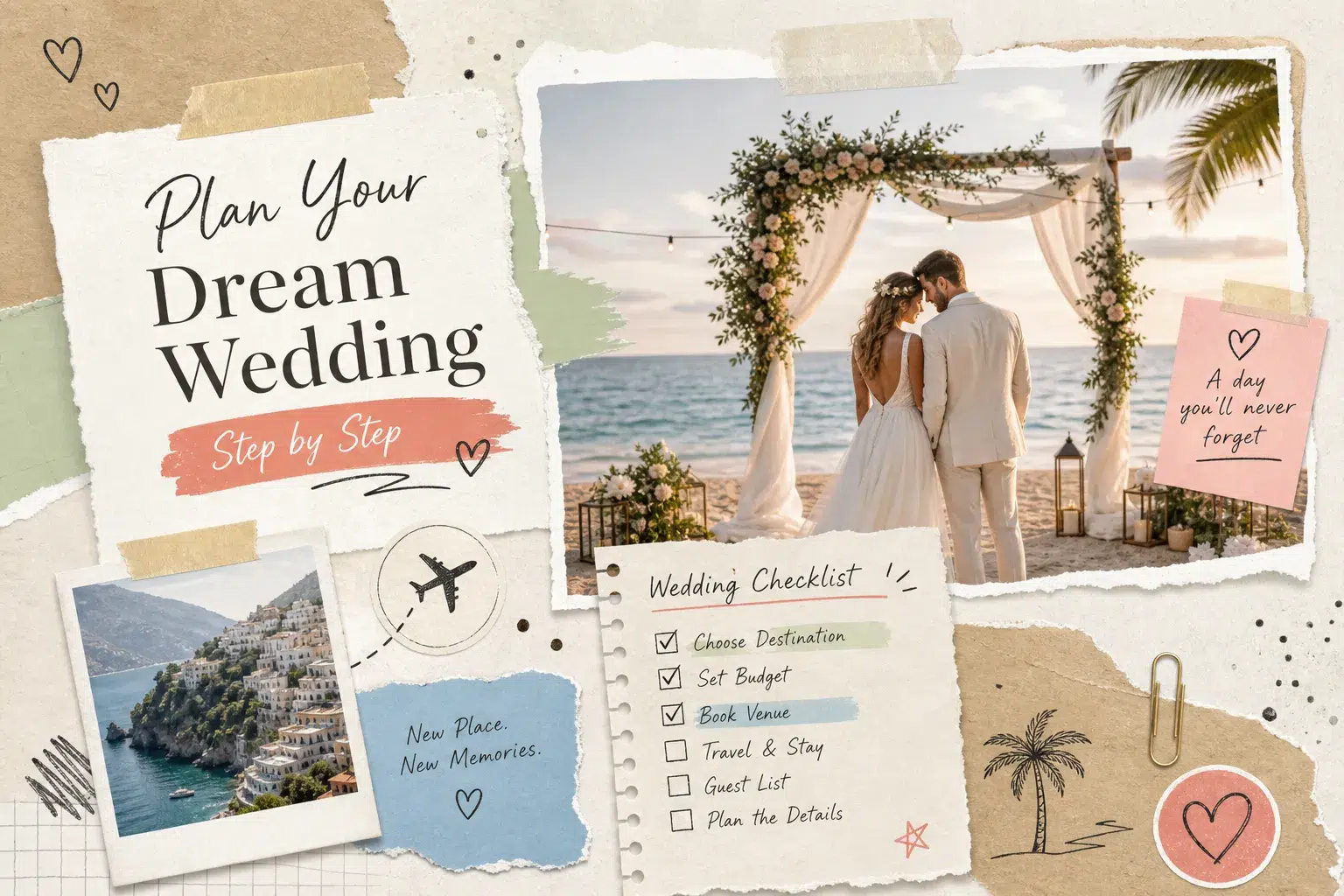
What Do I Need to Plan a Destination Wedding? The Full Checklist
Disclosure: This post may contain affiliate links. Teach Travel Discover is a participant in the Amazon Services LLC Associates Program as well as other affiliate programs. These are designed to provide a means for us to earn fees by linking to Amazon and affiliated sites at no extra cost to you. Please see our Privacy Policy for more details.
If you’re asking what do I need to plan a destination wedding, here’s the short answer: a real budget set before you fall in love with a resort, your legal documents started way earlier than you think, a venue booked 9 to 12 months out, a room block for your guests, and a timeline that keeps all of it in order.
That’s the answer. The rest of this post is the how.

I’ve been planning destination weddings for 10 years, mostly in Mexico and the Caribbean, and I can tell you exactly where couples go wrong. It’s almost never the big stuff. It’s the apostille nobody started, the room block nobody negotiated, the contract nobody read. So let’s walk through this the way I walk my own clients through it, phase by phase, in the order that actually works.
What Do I Need to Plan a Destination Wedding First? Budget and Destination
Start with your budget and destination 12 to 18 months out. Most Mexico and Caribbean resort weddings for 30 to 50 guests run $18,000 to $45,000.
I’m not going to lie, this is the phase most couples skip. They fall in love with a resort on Instagram, then find out the price tag, then spend three months trying to close a gap that never should have existed. Numbers first. Pretty pictures second.

How to pick your destination
The right destination isn’t about the view. It’s about logistics.
For US couples, Mexico and the Caribbean are the easiest wins. Direct flights from every major East Coast airport, resorts that host group weddings every single week, and coordinators who know exactly what they’re doing. Europe is doable, but expect higher vendor costs and a lot more paperwork.
Run every destination you’re considering through three filters: can your guests get there on a direct flight, what’s the weather like during your target month, and how complicated is it to legally marry there versus doing a symbolic ceremony. That third one matters more than people realize. We’ll get there.
What a destination wedding actually costs
For a 30 to 50 guest wedding at an all-inclusive in Mexico or the Caribbean, plan on $18,000 to $45,000 total. That covers the venue, catering, vendors, and your own travel.
Your guests should each budget roughly $1,150 to $2,500 for flights and their room. And if you’re flying in a photographer or any vendor from home, add $1,500 to $4,000 per vendor for their travel on top of their actual fee.
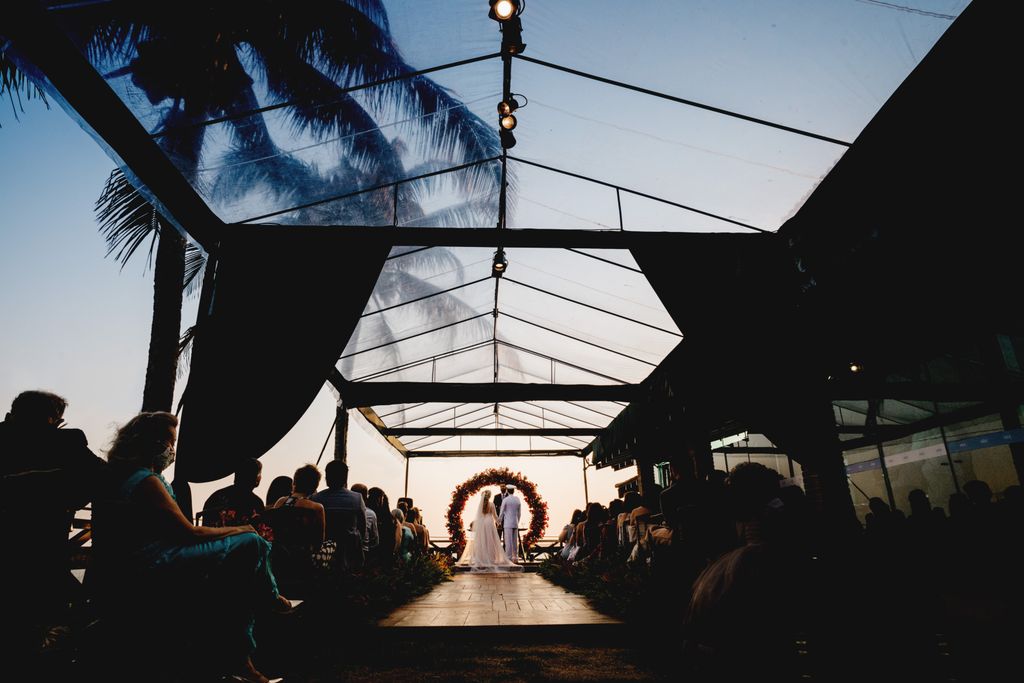
All-inclusive resorts are the most predictable way to budget because the package bundles your ceremony setup, cocktail hour, dinner, and a resort coordinator into one number. Photography, florals, and entertainment are usually add-ons. Know your total number before you request a single quote. Your budget decides your resort tier, not the other way around.
How far out you need to start
Twelve months minimum. Eighteen if you want a peak season date or a destination with stricter legal requirements.
Working with 9 months or less? It’s not impossible, but you’re doing things in parallel now, not in order. Venue deposit, legal research, and save-the-dates all happen at once. This is exactly the situation where having a planner stops being a luxury.
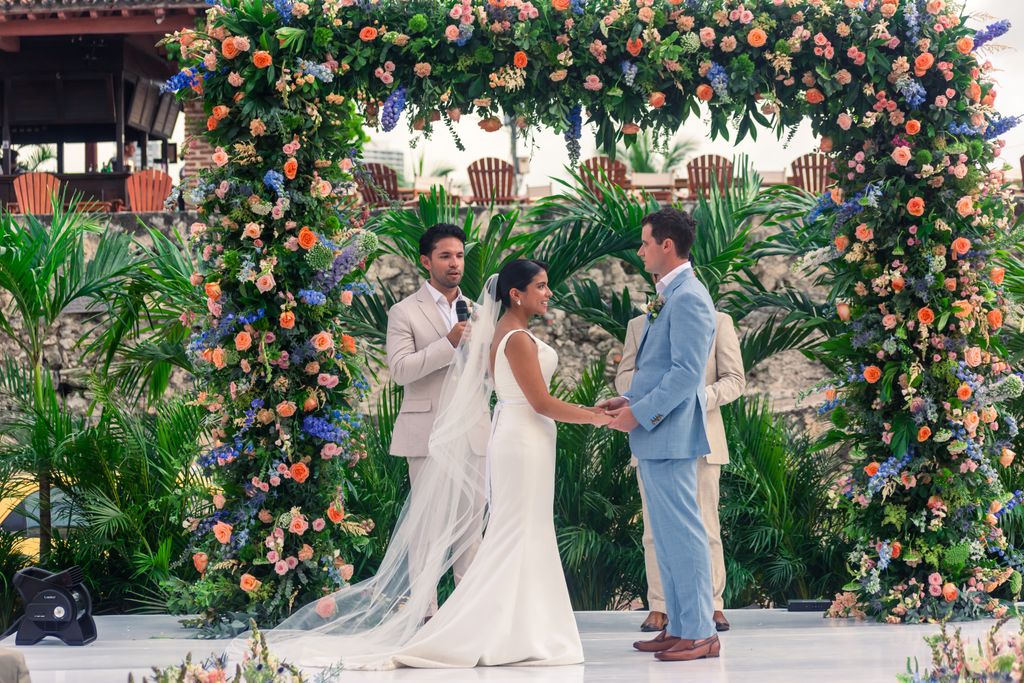
What Legal Documents Do I Need for a Destination Wedding?
You need valid passports, apostilled birth certificates translated into the local language, and country-specific items like blood tests or witnesses.
This is the section that separates the couples who glide through their wedding week from the ones panicking at a civil registry office in another country. And I’ve seen the panic version. It’s not cute.
Get this wrong and your marriage may not be legally recognized at home. So read this part twice.
Passports, apostilles, and translations
Most countries want your passport valid at least six months past your wedding date. Check yours today. Both of you. Right now.
Then there’s the apostille, which is a specific form of international notarization your birth certificate needs before another country will accept it. Your state’s secretary of state handles it, and processing takes 2 to 6 weeks depending on your state. This is not a 3-months-out task. If either of you was married before, the divorce decree needs an apostille too.
Most countries also require those documents translated into the local language by a certified translator. Does that make sense? Passport, apostille, translation. That’s the core stack.

Country-specific rules for the big three
Mexico is the strictest of the popular destinations, and it’s also my top seller, so I know these rules cold. You have to arrive 4 full business days before the wedding to file paperwork at the local civil registry. Blood tests for HIV, VDRL, and RH factor must be done in Mexico within 14 days of the wedding. Your results from home don’t count. I can’t make this up. You also need four witnesses over 18 with valid passports, though resorts can provide them for a fee.
The Dominican Republic wants passports, apostilled birth certificates, and single-status affidavits, all translated into Spanish, plus four witnesses. Jamaica is the easiest of the three: no residency period, just certified translations for anything not in English.
Requirements change, so always verify with the local civil registry or your planner before locking your timeline. This is honestly why a lot of my couples do the legal ceremony at their local courthouse and a symbolic ceremony at the resort. Same wedding, zero paperwork stress. Nobody in your photos will ever know the difference.
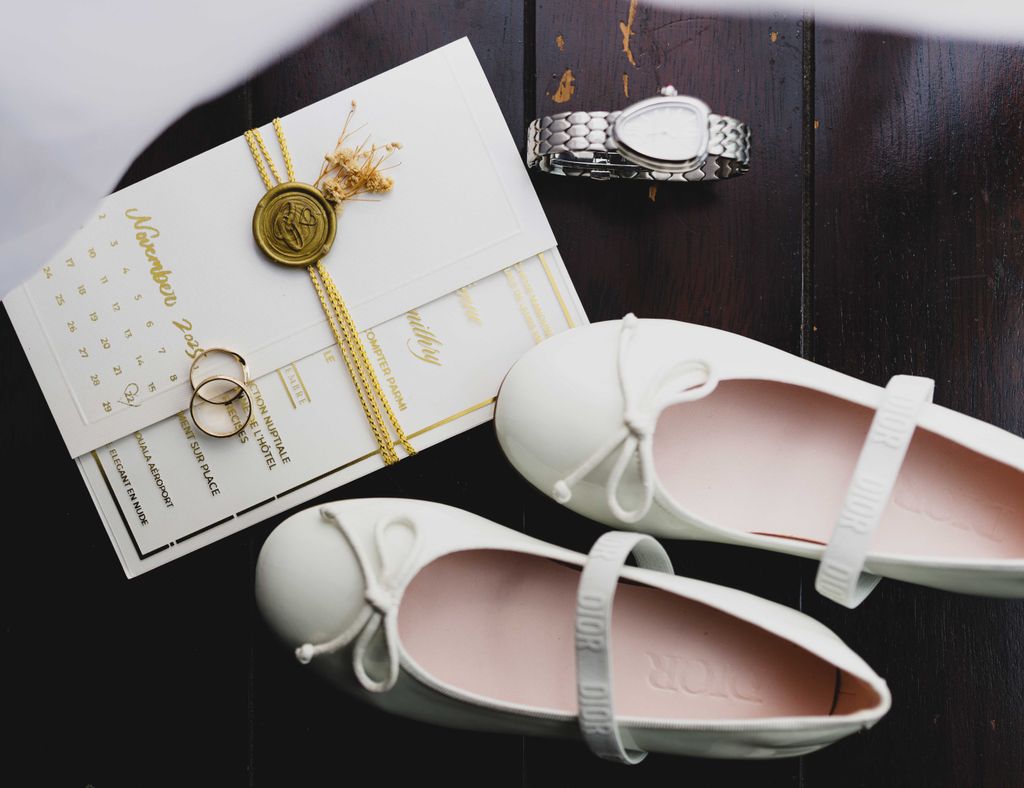
How Do I Choose a Destination Wedding Resort and Vendors?
Book your resort 9 to 6 months out. Judge it on outside-vendor policies, attrition terms, and what the package actually includes, not the photos.
The resort brochure will not tell you the things that matter. I will.
What to look for beyond the photos
Before you sign anything, get answers to these: Does the resort allow outside vendors, and what’s the fee? Some resorts charge thousands per outside vendor, and that fee can quietly kill your dream photographer. Is a real coordinator included, or just a sales contact? What are the attrition terms on the room block? Are there restrictions on ceremony locations or timing?
And then negotiate. Resorts offer perks for groups that hit a minimum night commitment: complimentary upgrades, welcome bags, a discounted honeymoon suite. But they don’t volunteer any of it. You have to know to ask. This is half of what I do for my clients, and it’s the half that pays for itself.
The vendor contract checklist
Here’s the part that surprises people: contracts with local vendors follow local law, not US law. If something goes sideways, the dispute gets resolved in their jurisdiction, not yours.
So before you sign, confirm the payment currency, the deposit structure with the refund policy in writing, the cancellation tiers, whether the vendor can subcontract your job to someone else, and where disputes get resolved. If the contract is in Spanish, get a certified translation before you sign, not after. And ask every vendor for a certificate of liability insurance.
Protective? Yes. That’s the job.
How Do I Handle Guest Logistics for a Destination Wedding?
Secure a room block 9 to 12 months out for 60 to 70% of your guest list, send save-the-dates immediately, and track bookings monthly.

Guest logistics is the part nobody warns you about. You’re not just planning your wedding. You’re indirectly managing travel for 30, 40, 50 people. And every one of them will have a question.
Setting up your room block the right way
Block rooms for about 60 to 70% of your out-of-town guests, not the full list. Some people will book on points, some will stay off-property, and some flat out won’t come. Blocking for everyone is how you end up on the hook for empty rooms.
Offer 2 to 3 room categories at different price points so your college roommate and your fiancé’s boss both have an option that works. Negotiate an attrition clause that lets you release unbooked rooms before the cutoff without penalty. Then request pickup reports monthly, and weekly in the final 6 weeks, so you can chase down the stragglers before the group rate expires. And there will be stragglers. There are always stragglers.
Your communication timeline
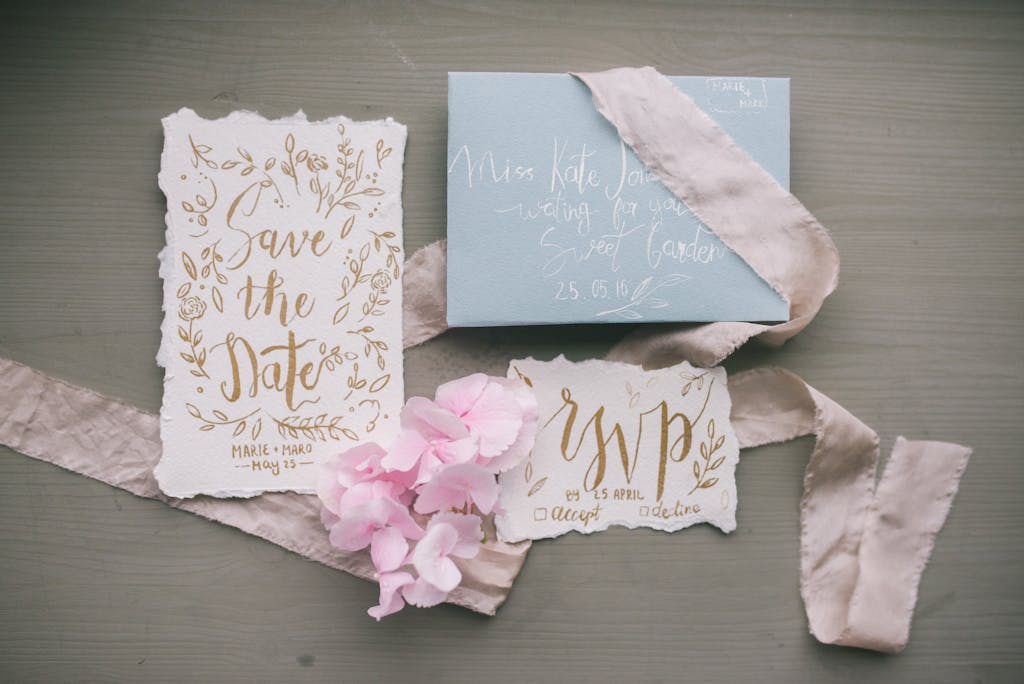
Save-the-dates go out 9 to 12 months before the wedding, with the booking link and cutoff date included from day one. Formal invitations at 6 months, which is earlier than a domestic wedding needs.
Your wedding website should answer every question before it lands in your inbox: flights from major airports, the booking link, passport requirements, weather, packing, the full weekend schedule, and an FAQ. Then send RSVP reminders at 8 weeks, 4 weeks, and one final nudge a week before the room block closes.
What Happens in the Final 3 Months Before a Destination Wedding?
Nothing new gets booked. Every existing vendor gets re-confirmed in writing, documents get verified, and you build your day-of timeline.
At 3 months out, you shift from planning mode to confirmation mode. The list is locked. Now you make sure everything on it actually happens.
The confirmation checklist
Re-confirm every vendor in writing with their deliverables, arrival time, and payment schedule. You want a paper trail for everything. Verify travel documents for both of you and your immediate family. Finalize the seating chart once RSVPs close. Confirm the catering headcount, menu, and dietary requests. Settle any vendor payments due and save the receipts.
Arrive early, and I mean it
Plan to land 3 to 5 days before the wedding. That window is for meeting your vendors in person, finishing any civil registry paperwork, hosting a welcome event for early arrivals, and actually breathing before your wedding day.
That last part only happens when the logistics are already handled. Which brings me to my final point.

Do I Need a Destination Wedding Planner?
Technically no. Realistically, one of you becomes an unpaid project manager tracking foreign contracts, document deadlines, and 40 guests’ travel questions.
Here’s the honest version. Everything on this checklist is doable. But it’s a multi-month project with foreign legal systems, contracts in another language, and dozens of people depending on you to get it right. Without a planner, one of you absorbs all of it while working full time. A missed apostille or an unread attrition clause doesn’t announce itself until it’s a crisis.
This is exactly what I do at Teach Travel Discover. One call, and I build the full plan: timeline, contract review, vendor coordination, room block negotiation, group perks, and guest communication from save-the-date through the wedding weekend. You keep complete creative control. I carry the logistics. And yes, I will have already invited myself to your wedding by then. Occupational hazard.
Frequently Asked Questions
What do I need to plan a destination wedding?
Five things: a budget set before venue shopping, valid passports plus country-specific legal documents like apostilled birth certificates, a resort booked 9 to 12 months out, a room block for guests, and a phase-by-phase timeline. A planner makes sure none of them slip.
How far in advance should I start planning a destination wedding?
Twelve to 18 months. Twelve is the practical minimum for an off-peak Mexico or Caribbean wedding. Peak dates, in-demand resorts, or destinations with stricter legal requirements need the full 18.
Do I need a destination wedding planner?
Not technically. But between foreign contracts, document deadlines, attrition clauses, and guest logistics, one partner usually ends up as a full-time project manager. A planner takes that entire layer off your plate.